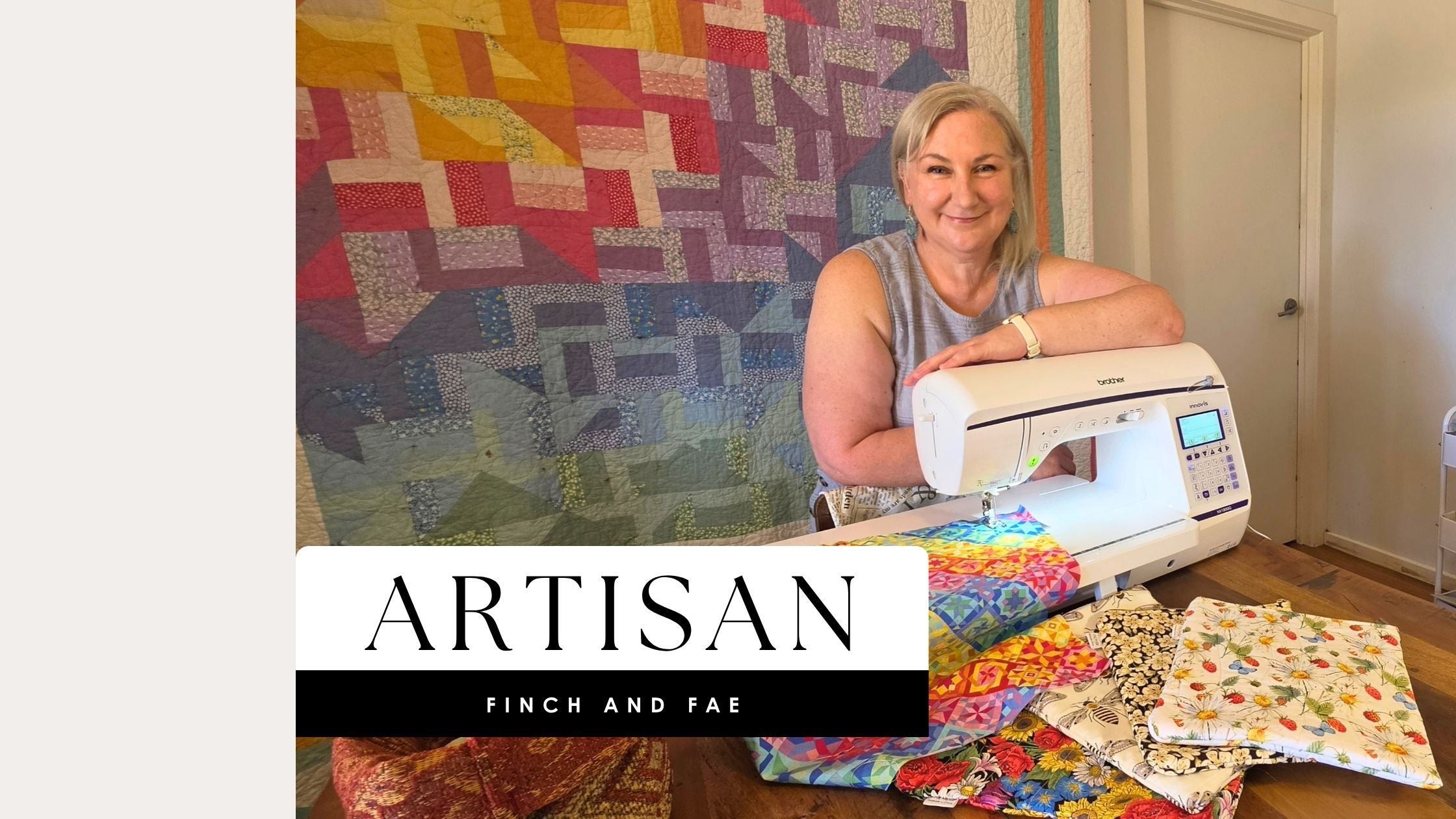
Introducing Kirstie from Finch and Fae. Where every item is handmade!! From her home in Wadawurrung country, Victoria, she uses reclaimed fabrics and 100% natural fibres and aims to use all parts of the fabrics in her sustainable creations.
Find out why Kirstie started creating and why she is so passionate about the value of handmade.

Tell us about your creations and your handmade process.
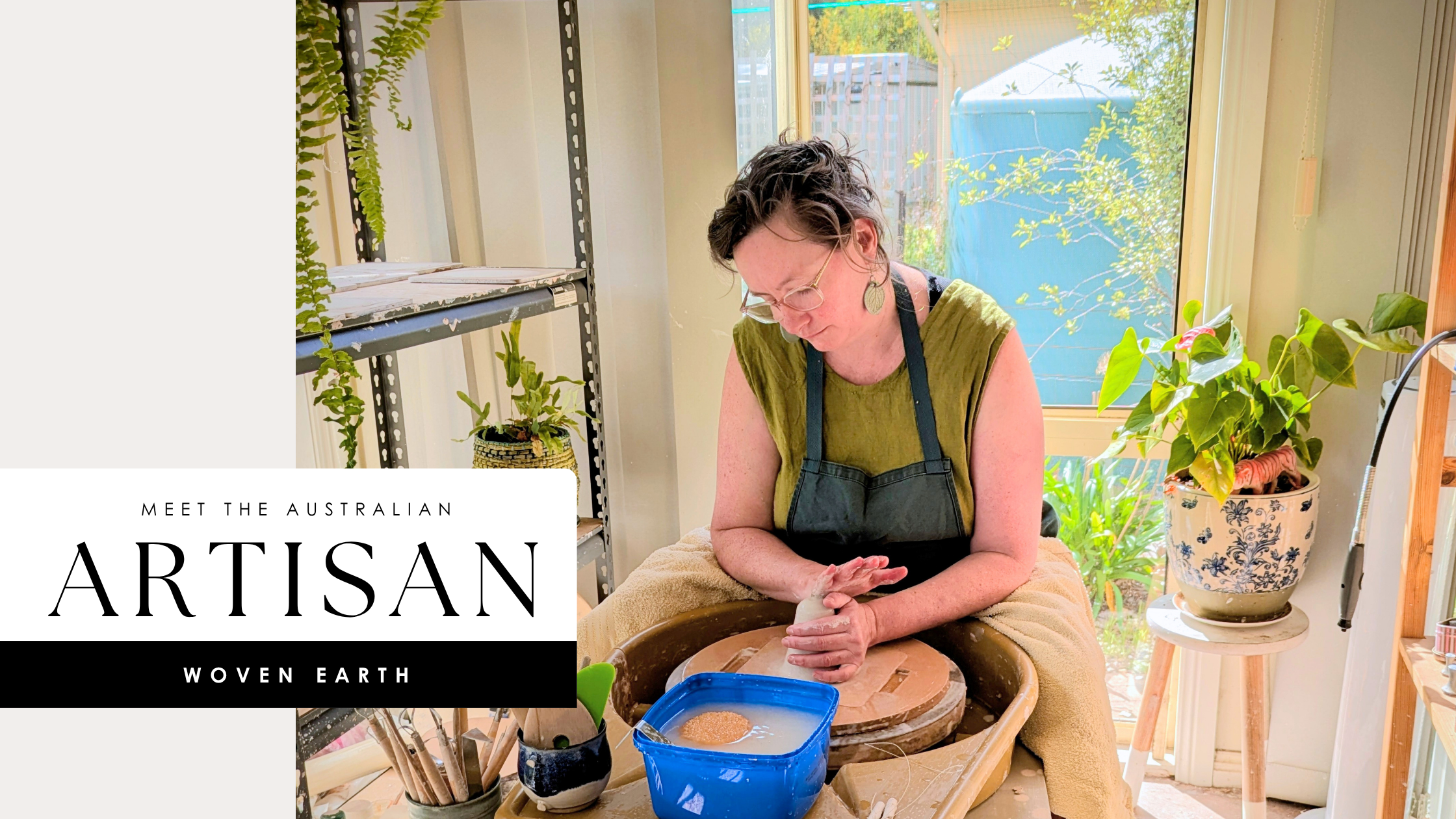
Sustainability is at the core of all Finch and Fae creations, which are made from upcycled, reclaimed or new fabrics, and/or designed to replace disposable items, such as microwave popcorn bags and totes. I work mainly at the dining table (and the coffee table, kitchen bench and foldable table) but hope to turn the spare room into a studio soon! Several generous furniture and upholstery businesses give me fabric sample books that would otherwise go to landfill, which become glasses cases and other items. I supplement this with new material, deadstock (or surplus stock) and remnants or end-of-bolt pieces.
I use all-new fabric in anything related to food as a safety precaution. Most of the reclaimed fabric needs to be taken off display boards, has stickers to be removed, and in most cases is also washed and dried. For me, the creativity and challenge is coming up with functional items that use these textiles that are of varying sizes, colours, fibres and feels; or seeing what I can make with fabric scraps as they become smaller and smaller so nothing is wasted.

Tell us a bit about your journey to becoming a handmade artist.
The short version: during covid, we replaced our wrecked carpet with hard floors, and soon after adopted a puppy, Charlie, whose barks and yips bounced off all the solid surfaces. The answer? The tapestry effect, but with quilts - using soft material wall hangings as a sound dampener. So I guess it all started with a dog! The long version: I've always loved all things creative.
I also write, and at school took every art-related subject I could. At university, alongside a Journalism major, I studied several art and architecture subjects and loved both the practical and theoretical side. I had the choice to continue studying this field as a post-grad, but took the 'practical' route of journalism. Most of my sewing and crafting was practical, such as curtains for the house or cushion covers. I made a lot of crochet rugs, knitted jumpers, was very into cross-stitch, and dabbled in pretty much anything I saw.
When I began working long hours as a journalist, and became unwell with a chronic illness, the creative pursuits fell away. I started sewing again when our son joined our family - he was a four-year-old energy explosion who loved dressing up. Suddenly I was self-learning how to make capes, doona covers and costumes. And I loved it! I've always admired the creativity and artistry of quilts, and how they developed as a way of using up scraps or patching textiles. Enter covid, the hard flooring and Charlie, and I was away. I made my first quilt - an abstract rainbow colour wash - without a pattern, or any knowledge about seam allowances, squaring, cutting or bias. It wasn't straight or square and a lot of seams didn't match - but I learned a lot, and it's still one of my favourite pieces.
I had found a way to create with fabric that was easy on my hands, and which I could do while working around the needs of my neurodivergent son.
After making quilts for most of my extended family, I moved into bags and household items, and became more interested in the environmental impact of fabric production - particularly fast fashion and manufactured fibres. Using up all the fabric and being more mindful about what I sourced and from where became priorities. It's a topic I'm still learning about, and no doubt will shape Finch and Fae's development. I've also found creativity in any of its forms to be invaluable for my physical and mental health. There's often pressure on creators to do 'something' with their works, whether that's sell, exhibit or make it functional, but the value and benefits of creating just for the sake of it, of getting into that flow state where it's just you and the work, should not be ignored.

What is your inspiration or where do you find inspiration?
I often get ideas when chilling out with my cat Finn. I love travelling, and find the colours and textures of nature in her birds, the landscape, animals, flora and changing seasons stimulating and inspiring. In 2024 my husband, son and I spent a fortnight volunteering at a turtle conservation centre on an island off Bali. Rubbish collection was part of the program, and the visible impact a throwaway culture has on the environment, particularly in areas that don't have the rubbish and recycling programs that Australia is lucky to have, was astounding. Plastic in particular floats across oceans, and I became more invested in sourcing natural fibres and clothing to avoid adding to the problem. While it would be fantastic to live a zero-waste, carbon-neutral life, it can seem overwhelming due to cost, location, time or other elements.
I'm a firm believer in the 'do what you can' philosophy - every change and decision helps. Small changes, like taking a refillable water bottle, reuseable coffee cups, and buying sustainable, local and handmade products, add up. And if you forget your water bottle one day - buy the water and recycle the bottle. I aim to make items that fulfil a function - whether that's stopping the fabric going to landfill or replacing a disposable item. Sometimes the inspiration comes from the fabric itself - a beautiful pattern might suit a particular product, or the size of the fabric will dictate what I can make from it. I'm always looking at what's available commercially and working out if I can do it in a different and more sustainable way.

Where did you learn your craft?
My grandmother was my first teacher - she was a seamstress during WWII and she'd teach me small projects on her old sewing machine, and I loved the way it folded down to be a piece of furniture! Mum also taught me, and I took sewing as an elective at school. I was the one who had to do the complicated applique design when everyone else was doing circles and squares; making a multi-panel swing skirt instead of a straight design; and trying funky fabrics instead of the plain designs my classmates preferred. In fact, my teacher suggested I find another elective for the following year!
When I decided to start sewing again several years ago, I watched a lot of YouTube tutorials, including the late Donna Jordan, Missouri Quilt Company, Christine's Home Affairs and Teresa Downunder. I also took classes at Bellarine Sewing Centre in Geelong and gradually added to my skill set. I've always loved learning, and while I still refer to books, online resources have been incredible for skill-building.
Why is handmade artistry so important to you?
It feels like we're at a turning point where the economics of mass and centralised production are failing. Inexpensive products have high social and environmental costs, and as AI design becomes more prevalent, handmade increasingly is becoming an act of rebellion. No matter how advanced, I can't see any AI making the random connections the human brain does in creating unique or new or whacky or 'it's weird but it just works' handmade pieces.
I've always been drawn to handmade artistry - whether its jewellery or homewares or clothing, I can feel the energy that's been put into it by the maker. No two pieces are ever identical - even if that's the intent. The combination of handmaking with natural materials, which often seem to have their own ideas, is the antithesis of mass production. In many countries, specific villages are known for and pride themselves on just one type of artwork. Through mass production we have lost a lot of what makes individual places and communities unique, and we have power as consumers to turn that around. Support a local maker and you support the local community.

As one of our MadeIt Artisan Meet-up Hosts, what do you love most about these Meet-ups and being a host?
The community is so supportive and helpful, and the chance to get together and connect over all things creative and not has been and inspiring and welcoming experience. It feels like we're at a turning point where the economics of mass and centralised.

Kirstie is a much loved member of the MadeIt Collective, posting regularly in our Facebook Group ~ MadeIt: Handmade not Massmade Australia ~ and sharing her new creations as they are released. If you haven't connected with Finch and Fae make sure you join our FB Group and say hi !